Choosing a carbon fiber water fed pole supplier involves more than comparing pole length and unit price. For distributors, importers, commercial cleaning companies, and private-label buyers, the larger risk is often hidden in inconsistent materials, weak clamps, incompatible replacement sections, poor packaging, or limited after-sales support.
A pole that looks competitive on a quotation can become expensive if it flexes excessively at working height, arrives with transit damage, or cannot be repaired with readily available parts. A strong procurement process should therefore evaluate the complete product system—not only the pole tube.
This guide from Cleafou outlines the technical, commercial, and operational questions B2B buyers should ask before selecting a carbon fiber water fed pole supplier.
Start With Your Target Customer and Use Case
Before requesting prices, define who will use the pole and what work it must perform. A product designed for occasional two-story residential cleaning may not meet the expectations of a professional crew using it every day.
Clarify the following:
- Primary market: residential, commercial, facility maintenance, solar panel cleaning, or mixed use
- Typical working height
- Frequency and duration of use
- Desired collapsed length for storage and transport
- Required brush, hose, and fitting compatibility
- Need for modular extensions
- Expected climate and temperature range
- Whether the product will be sold under your own brand
- Target retail position: entry-level, professional, or premium
This information gives the supplier a useful specification. Without it, quotations may appear comparable while describing products built for different users.
1. Ask What “Carbon Fiber” Actually Means
The phrase “carbon fiber pole” does not describe one universal construction. Pole sections may use different fiber content, layup patterns, resin systems, wall thicknesses, and reinforcement methods. Some products may also combine carbon fiber with fiberglass or other materials.
A B2B buyer should ask:
- Is the construction full carbon, hybrid carbon, or a mixed-material design?
- Are all sections made from the same material specification?
- How are high-stress areas reinforced?
- What is the wall-thickness tolerance?
- How is the surface finished and protected?
- Can the supplier explain the intended performance difference between available grades?
Avoid evaluating material quality by appearance alone. A glossy finish does not confirm fiber content, rigidity, impact resistance, or manufacturing consistency.
If material grade is important to your market positioning, request clear written specifications and ensure that the production sample matches the approved sample.
2. Compare Working Rigidity, Not Just Product Weight
Low weight is valuable because it reduces operator fatigue. However, a very light pole that bends or twists excessively can be difficult to control at height.
Rigidity affects:
- Brush placement on the glass
- Pressure transfer during agitation
- Control around frames and edges
- Accuracy in windy conditions
- Operator comfort during extended use
- Perceived product quality
When comparing samples, extend each pole to the same usable length and install the same brush or equivalent load. Observe lateral flex, rotational movement, recovery after bending, and clamp stability.
Published weight should also be defined carefully. Ask whether the stated figure includes clamps, hose, adapter, brush, and extension sections. Two weight figures are not comparable when they describe different configurations.
3. Confirm Actual Working Reach
Nominal pole length and practical cleaning height are not the same measurement.
Actual reach is affected by:
- The operator’s height
- The distance from the building
- The angle of the pole
- Obstacles such as porches, roofs, landscaping, and solar arrays
- Brush-head length
- The amount of section overlap required for safe use
Ask the supplier to distinguish among:
- Physical pole length
- Recommended maximum extended length
- Approximate working reach
- Length with optional extensions
- Collapsed transport length
Marketing a pole by an unrealistic reach figure can create returns and customer dissatisfaction. For distributors, clear product-page definitions are as important as the measurement itself.
4. Inspect Clamps and Section Connections
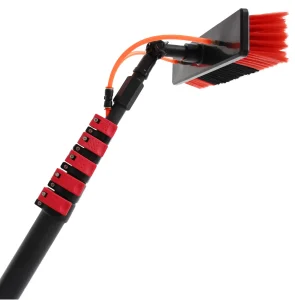
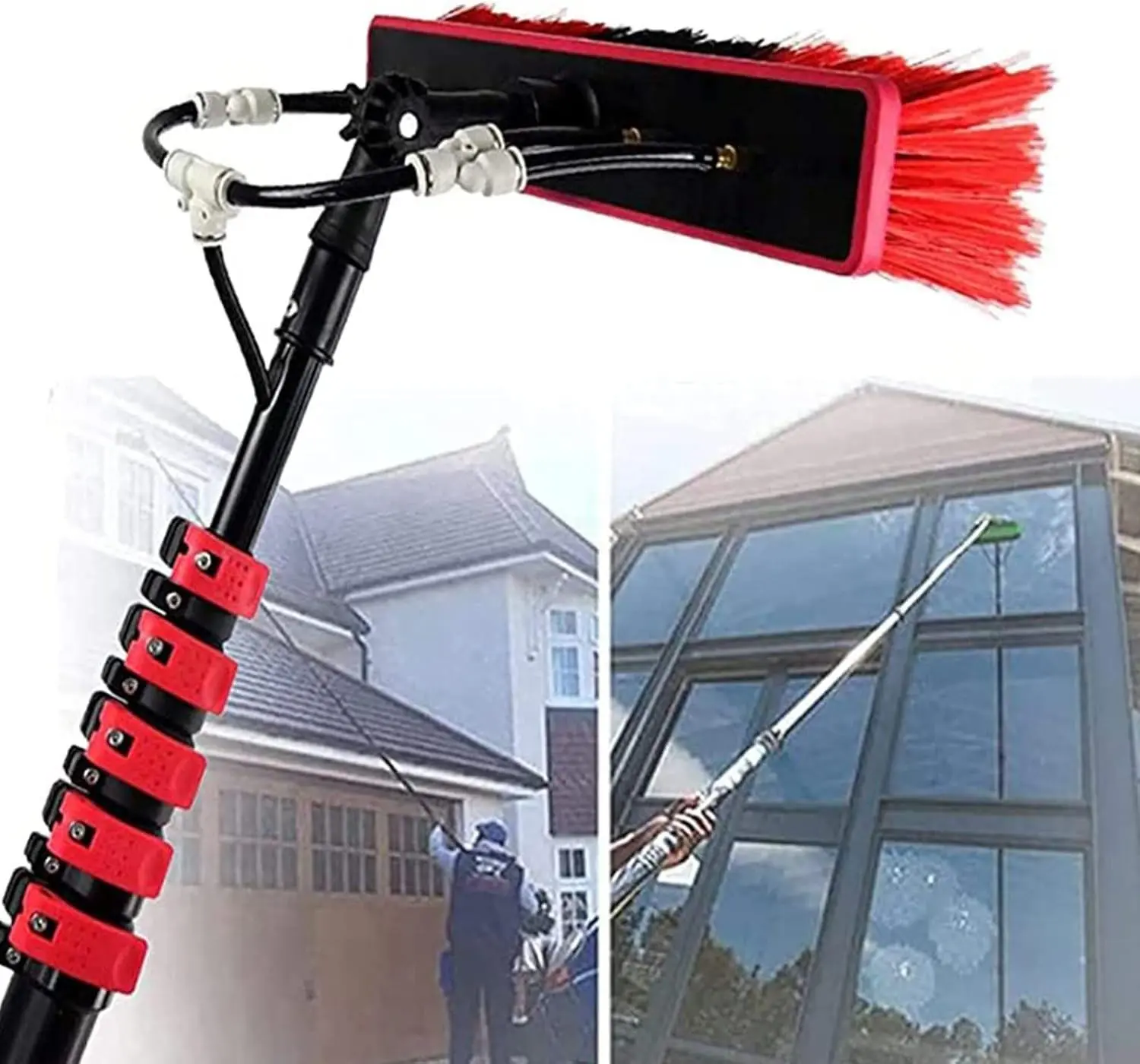
Clamps are among the most frequently handled components on a telescopic pole. Their design directly affects setup speed, section slippage, maintenance, and field repair.
Evaluate:
- How easily the clamp opens and closes
- Whether the tension can be adjusted
- How firmly it holds a wet or extended section
- Whether the lever has uncomfortable or sharp edges
- Whether clamp parts are replaceable
- Whether tools are required for normal adjustment
- How the clamp is attached to the pole section
- Whether section rotation occurs under brush load
Repeatedly extend, lock, twist, and collapse the sample. A clamp that performs well during a short inspection may behave differently after contamination with water and fine grit.
Ask the supplier how clamps are tested and whether replacement clamp bodies, levers, bolts, and pads can be ordered separately.
5. Verify Replaceable Sections and Spare-Part Availability
Professional poles can be damaged during transport, dropped at a jobsite, or crushed by vehicles. A replaceable section can turn a major product failure into a manageable repair.
Before ordering, confirm:
- Whether individual pole sections are available
- How sections are identified for reordering
- Whether replacement sections are interchangeable across production batches
- Which clamps and adapters are stocked as spare parts
- Whether repair instructions or diagrams are available
- How long the supplier expects to support the product generation
For distributors, consider stocking common service parts alongside the main product. Spare-part availability reduces warranty costs, shortens downtime, and gives professional customers more confidence in the product line.
6. Check Brush, Adapter, Hose, and Fitting Compatibility
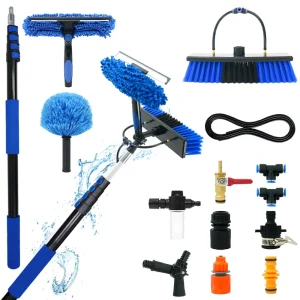
A water fed pole is part of a complete cleaning system. Buyers should confirm that the pole works with the accessories their customers already use or plan to purchase.
Review compatibility for:
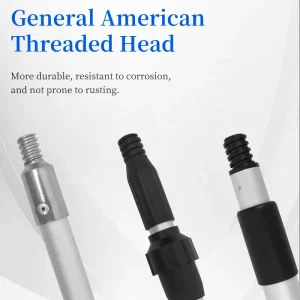
- Brush-head threads or adapters
- Fixed and swivel necks
- Pencil jets, fan jets, and rinse bars
- Internal or external hose routing
- Hose diameter
- Quick connectors and shutoff valves
- Scrub-pad holders
- Traditional window-cleaning tool adapters
- Optional extension sections
Ask whether the supplier uses a proprietary connection or a commonly supported format. Proprietary designs are not automatically a problem, but buyers need a reliable source of compatible accessories and replacement parts.
If your company intends to sell a complete kit, test the exact brush, hose, fittings, and filtration unit together. Do not approve each component only in isolation.
7. Evaluate the Brush as Carefully as the Pole
The brush controls agitation and water distribution. A good pole paired with an unsuitable brush can still produce a poor customer experience.
Consider:
- Bristle material and stiffness
- Brush width and weight
- Splay and contact around frame edges
- Water-channel design
- Jet placement
- Rinse-bar options
- Swivel-neck movement
- Replaceable jets and hose connections
- Performance on hydrophilic and hydrophobic glass
Define the intended cleaning task. Synthetic, hybrid, and natural-bristle brushes have different characteristics. The best standard configuration for a distributor may be a durable general-purpose brush, with more specialized brushes offered separately.
8. Request a Clear Quality-Control Process
A strong sample is useful, but B2B buyers need confidence that production units will match it.
Ask the supplier which checks are performed on incoming materials, during assembly, and before shipment. Depending on the product, relevant inspections may include:
- Pole length and collapsed length
- Tube diameter and fit
- Weight tolerance
- Surface finish
- Section extension and collapse
- Clamp holding performance
- Adapter alignment
- Hose path and connector fit
- Brush and jet function
- Visual damage and packaging condition
Do not assume that a supplier performs a specific test unless it is documented. If your business needs particular acceptance criteria, include them in the purchase specification and pre-shipment inspection plan.
For larger orders, use an approved sample or signed specification sheet as the reference standard.
9. Test a Production-Representative Sample
A sample should be evaluated under realistic conditions, not only on a desk.
Suggested sample checks include:
- Measure the extended and collapsed length.
- Weigh the agreed configuration.
- Extend and collapse every section repeatedly.
- Test clamp holding power under a wet brush load.
- Check flex and rotational control at working height.
- Run water through the complete hose and brush assembly.
- Inspect jets, connectors, and swivel movement.
- Clean several window types under normal working conditions.
- Examine the pole after transport and repeated use.
- Confirm that available spare parts fit the sample.
Record the results and communicate any required changes in writing. When possible, request that the approved configuration be identified clearly in the final quotation and purchase order.
10. Review OEM and Private-Label Options Carefully
OEM customization can help distributors differentiate their product range, but every customization adds decisions, cost, and production risk.
Possible options may include:
- Logo placement
- Pole graphics or labeling
- Packaging design
- Instruction manuals
- Brush configuration
- Hose length
- Connector selection
- Adapter type
- Kit contents
- Replacement-part packaging
Ask which changes affect minimum order quantity, tooling, sampling time, unit cost, and lead time. Confirm who owns any custom artwork or tooling and how revisions are approved.
Keep the first private-label configuration practical. A reliable core product with clear packaging and the correct accessories is often more valuable than excessive cosmetic customization.
11. Examine Packaging and Shipping Protection
Long, lightweight components require packaging that protects them from crushing, bending, abrasion, and moisture during international transport.
Discuss:
- Individual pole protection
- Carton strength and dimensions
- Internal supports or end protection
- Brush and accessory separation
- Labeling and barcode requirements
- Pallet configuration
- Mixed-product shipments
- Replacement packaging for distributors
Request sample packaging photos or a packed sample when possible. Also consider how the carton will move through your own warehouse and parcel network after import.
Packaging that survives a pallet shipment may not be sufficient for individual last-mile delivery to your customer.
12. Compare Total Cost of Ownership
The lowest unit price does not always create the best gross margin.
Include the following in your evaluation:
- Product cost
- Packaging
- Freight and import costs
- Inspection expenses
- Replacement parts
- Warranty claims
- Transit damage
- Customer support time
- Product returns
- Inventory held for service parts
- Cost of incompatible accessories
A slightly higher purchase price may be commercially preferable if the product is consistent, repairable, well packaged, and supported with parts.
Build a comparison sheet using the same configuration and commercial terms for every supplier. Otherwise, a low quotation may simply omit accessories, spare parts, packaging, or quality requirements included elsewhere.
13. Assess Communication and Documentation
Reliable communication is a procurement requirement, not merely a convenience.
Evaluate whether the supplier:
- Answers technical questions clearly
- Identifies assumptions in the quotation
- Confirms revisions in writing
- Uses consistent product codes
- Provides packaging and specification details
- Explains what is and is not included
- Responds constructively to sample feedback
- Can provide product images, manuals, and sales information where agreed
Avoid relying on important details that exist only in informal messages. Consolidate the approved specification, accessories, packaging, labeling, quantities, and commercial terms into the purchase documents.
14. Ask About MOQ and Lead Time Without Making Assumptions
Minimum order quantity and production time vary according to configuration, customization, packaging, material availability, and current factory schedule.
Ask the supplier to separate:
- MOQ for standard products
- MOQ for custom branding
- MOQ for custom packaging
- Sample preparation time
- Production lead time after approval
- Time required for replacement parts
- Conditions that may change the schedule
Do not plan a product launch around an unconfirmed estimate. Allow time for sample approval, packaging review, inspection, freight, customs clearance, and warehouse receiving.
Red Flags for B2B Buyers
Investigate further if a potential supplier:
- Cannot explain the pole’s material construction
- Provides reach claims without defining pole length
- Avoids supplying replacement-section information
- Cannot identify compatible brushes or fittings
- Changes specifications between conversations
- Offers customization without an approval process
- Provides no clear packaging details
- Resists production inspection or agreed acceptance criteria
- Quotes a complete kit without listing included components
- Makes performance claims that cannot be demonstrated or documented
One concern does not automatically disqualify a supplier, but unresolved ambiguity increases procurement risk.
Carbon Fiber Water Fed Pole Supplier Evaluation Checklist
Before approving an order, confirm that you have reviewed:
- Target customer and application
- Material construction
- Pole weight and configuration
- Rigidity at working length
- Physical length and practical reach
- Collapsed transport length
- Clamp performance and adjustability
- Replacement sections and spare parts
- Brush, hose, jet, and fitting compatibility
- Complete-kit water flow
- Quality-control and inspection criteria
- Production-representative sample
- OEM artwork and packaging approval
- Carton and shipping protection
- MOQ, lead time, and commercial terms
- Warranty and claim-handling process
- Total landed and after-sales cost
Frequently Asked Questions
What is the most important specification for a carbon fiber water fed pole?
There is no single specification that determines overall quality. Buyers should evaluate material construction, working rigidity, weight, clamp performance, reach, accessory compatibility, and spare-part support together.
Is a lighter water fed pole always better?
Not necessarily. Low weight reduces fatigue, but insufficient rigidity can make the brush difficult to control. Compare poles at the same working length with an equivalent brush load.
Should distributors stock replacement pole sections?
For professional products, stocking common sections, clamps, adapters, and connectors can reduce downtime and improve after-sales service. Confirm part compatibility before building inventory.
What should be included in a water fed pole sample test?
Test length, weight, clamps, flex, rotation, hose routing, brush function, water flow, accessory fit, repeated extension, field cleaning performance, and packaging condition.
What information should be included in an RFQ?
Include required lengths, material level, target weight or performance, brush type, hose and fittings, adapters, packaging, branding, quantity, spare parts, destination, inspection requirements, and requested commercial terms.
How should buyers compare supplier quotations?
Compare quotations using the same configuration and scope. Confirm which brush, hose, fittings, adapters, spare parts, packaging, branding, inspection, and shipping terms are included before comparing unit prices.
Build a Supply Program, Not Just a Product Order
The most successful B2B sourcing decisions consider the full product lifecycle. A carbon fiber water fed pole must perform at height, survive transport, accept the right accessories, and remain serviceable after it reaches the customer.
Start with a clear use case, test a representative sample, define acceptance criteria, and confirm replacement-part support. Then compare total cost rather than relying on the lowest quoted unit price.
If you are sourcing water fed poles for distribution, wholesale, or private-label sales, Cleafou can discuss product configurations, accessories, packaging, and project requirements based on your market. Visit cleafou.com, request product information, or contact sales@cleafou.com to begin a B2B inquiry.